Odd but Understandable? Sorry, I don’t buy it.

A Dog Have I.

What do you think of this sentence? Bizarre? Incorrect grammar? Odd but understandable?

This is one of the examples from Post Editing Guidelines For BOLT Machine Translation Evaluation rule 3.5, indicating that this kind of sentence structure is “readily understandable“, and the rule suggests “DON’T rearrange the phrases just to improve the fluency“.

From my personal perspective, translation like A dog have I” is NOT acceptable, at least not in English (Maybe in German it’s fine, “Ich habe einen Hund” = “Einen hund habe ich“). The question I’m having is: Where do we draw the line? Theoretically, a “dog” can be a subject in the sentence. Why can’t “I” be owned by a dog?

The other examples in the rule meet the requirement of “odd but understandable”, but what if the whole translation is full of those kind of sentences with chaotic word order? How would that impact the readability? 

Maybe the reason why I’m having doubt is that I’m not a native English speaker. Interestingly, in Chinese, there was a similar popular test on the sequence of character order that I totally understand: 

研表究明,汉字序顺并不定一影阅响读。(The study shows that the sequence of Chinese characters does not affect readability.)

The sentence above is not written with correct character order but Chinese people won’t have any trouble reading it. What happened here is that our brains auto-corrected the mistakes in the sequence. When we read Chinese, we tend to segment the sentences into several chunks. Each chunk consists of several characters. We absord information chunk by chunk and we pay less attention to individual characters.

Back to English. I have asked ChatGPT to generate a paragraph specifically with sentences that have wrong word order:
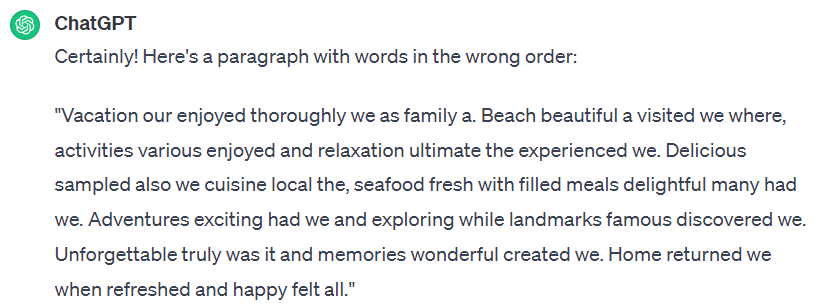
To be honest, this looks like a disaster to me. But I’m curious about what you (especially native English speakers) might think. Feel free to leave comments!

Project Showcase: LAWful Translation

LAWful Translation is named after the initials of the three founders: Lide, Amory and Winston (yep, that would be me). We came up with the name to finish our semester-long project in the Translation Technology class. This project showcase includes proposal, deliverables and our key takeaways on the usage of CAT tools and translation workflows.

Introduction

The scenario is that we (LAWful Translation, translation vendor) are delegated with a translation job by our client (China Energy Conservation and Environmental Protection Group, CECEP for short). The specific objectives of this localization project, forming part of the broader commitment under previous overarching contract, is for us to deliver the localized content of the 2023 CSR report from Chinese to English.

Tasks and Deliverables

TasksDeliverables
Creation/Update of the term base and translation memory regarding this projectTerm base in .xml format; translation memory in .sdltm format
Creation/Update of the style guideStyle Guide in .pdf format
Pseudo-translation of the same documentPseudo-translation in .docx and .pdf format
Chinese to English Translation of the Social Responsibility ReportTranslated document in English in .docx and .pdf format
One round of Proofreading and Editing(same above)

Process & Timeline

Lessons Learned

Considering the client has provided the translated version of the report from 2022, we took that into consideration and worked on the quote with reasonable discount based on fuzzy matches. By creating the translation memory with the alignment of that version, we are able to finish the translation in a much shorter time.

One thing during our kick-off meeting with the client is that he asked about involving a reviewer from his side in our workflow. We weren’t sure about where exactly we should implement that step but later after some discussion, we have decided to involve the reviewer as early as possible. 

The reason is that the reviewer should be informed about the style guide prior to the translation. If their participation is too late, we might face a lot of back and forth during the translation or even after the translation is done. 

However, one thing I would like to point out is that whenever we involve an external personnel, especially from the client side, we must treat with extra caution. It takes time to familiarize the cooperation and one way to keep things professional is to create a “review form” visible to both sides, logging all the feedback and addressing them with care.  

I believe when we perform in a professional way, we can work out any disagreements.

Documents

A career path to localization

In June 2021, I was leading the Chinese Dubbing Team at Iyuno-SDI, a front-runner media localization provider, when we suddenly received a huge amount of dubbing orders from Disney+. The new projects with seemingly unreasonable deadlines would increase our team’s workload four to five times. I thought that it was impossible for us to complete them in time. At this crucial moment, my regional director helped me negotiate with the client and reorganize the deadline for some less urgent projects, lessening our burden significantly. Thanks to her support, I grew more confident and led my team through this challenging three-month period by redistributing a portion of the projects to external vendors and maintaining high morale with well-negotiated payments distributed to our in-house employers.

As rewarding as it was, my experience with the Disney+ projects led me to rethink my career path. As an aspiring professional who has worked in the localization industry for more than five years, I found it difficult to move up the career ladder due to a lack of systematic knowledge and an advanced degree. I hope to improve my negotiation skills and problem-solving techniques and become someone who faces challenges without fretting. This goal has been a key driver for me to apply for the Master of Arts in Translation and Localization Management (TLM) degree from Middlebury Institute of International Studies (MIIS).

Luckily, I was admitted. Now, here I am, located in a beautiful town on a completely strange continent, struggling in the second week of the new semester, writing this post, thinking about the TLM happy hour party I attended last night and imagining what my life will be like in the future.

Of course I would like to continue working in the localization industry. With my experience managing both domestic and international projects as well as leading dubbing teams, I believe the best next move is to join a client-side company. I am also open to different industries that require localization services, such as software or gaming. At the end of the day, all I wanted to achieve is to provide a better, localized experience to global audiences and users.