
Copyright Disclaimer: under section 107 of the Copyright Act of 1976, allowance is made for “fair use” for purposes such as criticism, comment, news reporting, teaching, scholarship, education, and research. This project is a proof-of-concept, and as such does not represent nor infringe on the creator(s) in any way.
Introduction
The purpose of this project is to simulate the enterprise software evaluation and selection process for a company that needs to invest in the purchase of a TMS (Translation Management System). We will discuss how a TMS will help our chosen company, Tesla, as it’s having a more prominent global presence.
Our team provides high quality translation and localization services to support Tesla’s global operations. We help ensure that all production information, marketing materials, technical documentation and customer support content are accurately translated and culturally adapted for Tesla’s diverse international markets.

Tesla’s Pain Point
Tesla is building a world powered by solar energy, running on batteries and transported by electric vehicles each year. Tesla’s global strategy prioritizes a unique distribution network built around company-owned stores and service centers. This approach allows for direct customer experience by controlling the distribution network. Tesla tailors the customer service from the point of sales through servicing during this process, ensuring consistent brand messaging while providing customized experiences, which has become more difficult as they continue to expand business to new markets.
Efficiency issues are becoming increasingly prominent as a result of customization. We proposed a solution that allows for customization, consistency and efficiency all at the same time, which will definitely speed the efforts to reach our common goal without bringing extra workload.
Our approach
Since this is a big investment, we must not only make a choice but also persuade others to buy into our choice. We need to persuade them by designing and sharing a reasonable evaluation process.
The first thing we did was to justify our recommendation about TMS. We started by identifying requirements from different stakeholder teams, including IT department, Research and development department, marketing and legal team, in-house translators, and our major vendors. The top eight requirements are integration, cost, workflow customization, automation, user-friendliness, scalability, support and training, and security. Based on these essential requirements, we compared two major providers: Phrase and Smartling.

By identifying and weighing the requirements in a scorecard, we are able to evaluate the pros and cons of each TMS, therefore deciding which TMS is the best choice for our client. The evaluation scoring scale is divided into five levels from 1 to 5.
As for the weights, it is designed with consideration taken into by two factors. The first one is the past experience from the language services department, and the second one is the final result of the collected feedback about the priorities among all these requirement.
Based on the weights assigned and the actual scores, the final results tilts toward Smartling, winning by a margin of 0.4, which is largely due to its overall better performance in terms of automation, scalability, and integration.
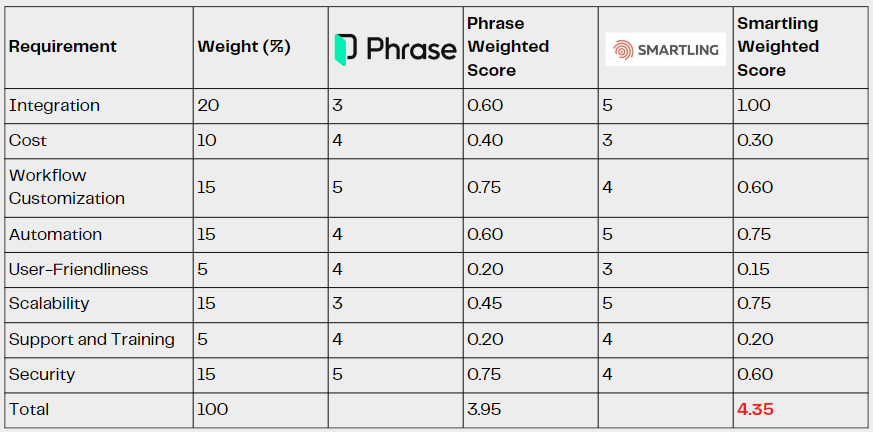
So up to this point, the choice is easy to make. The winner is Smartling and that’s what we are going to propose to the client.